

AI adoption · Australia · 2026
AI Usage & Adoption Statistics in Australia (June 2026)
More than half of Australians now use AI tools in any given month. That number was in the single digits two years ago. The shift from curiosity to daily habit has happened faster here than almost anywhere in the world. The trust picture and the business adoption story are more complicated than the headline figures suggest.
01 National adoption snapshot
58% of Australians use AI monthly. But "use" covers a lot of ground.
Roy Morgan's March 2026 survey is the freshest nationally representative data available. It shows 13.6 million Australians aged 14 and older used AI tools in an average four-week period during Q1 2026. That's 58% of the demographic. A separate, more conservative measure from the Australian Digital Inclusion Index (RMIT/Swinburne, April 2026) put the figure at 45.6%, using a tighter definition and a methodology that includes non-internet users. Both numbers represent a significant jump from the 30-38% range measured in early 2024.
The gap between the two studies is worth understanding, not dismissing. The Digital Inclusion Index explicitly includes Australians who don't have internet access or face barriers to filling in an online survey. Roy Morgan's broader figure reflects the reality for internet-connected Australians. The lower figure reflects a harder truth: AI adoption is not uniform. The people not using these tools tend to be older, less educated, and in lower-income households. There's a genuine AI divide forming in Australia, tracking almost exactly the same lines as the earlier digital divide.
Internet-connected population. Roy Morgan, Q1 2026.
Nationally representative sample including non-internet users. RMIT/Swinburne Digital Inclusion Index.
Up from 38% in 2023. Google/IPSOS survey.
The number that matters most to marketers
12% of Australians now identify AI tools as their primary way of finding information online. Up from 5% twelve months ago, according to Telsyte. One in eight of your potential customers may have already formed an opinion about your business based on what an AI tool told them, before they ever visited your website.
02 Platform breakdown
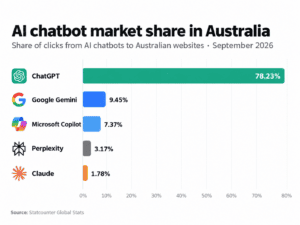
ChatGPT leads, but the platform picture is more distributed than most people realise
Telsyte's June 2026 research gives the most granular platform-level data for Australia. ChatGPT is the dominant tool with 13.8 million users, but the market behind it is broader than the public conversation suggests. Google Gemini at 9.1 million, Meta AI at 5.6 million, and Microsoft Copilot at 5.4 million are all meaningful. The next tier includes Apple Intelligence (3.9M), Samsung Galaxy AI (3.1M), Claude (2.9M), Canva AI (2.8M), Grok (2.5M) and CapCut (2.4M).
The embedded platform numbers deserve attention. Google Gemini's 9.1 million users includes everyone encountering AI Overviews in Google Search. That's a passive interaction that many Australians wouldn't identify as "using AI". Meta AI is built into WhatsApp and Instagram. Copilot is in Windows. These integrations mean actual exposure to AI outputs in Australia is far higher than any adoption survey captures. Australians are encountering AI-generated content constantly without framing it that way.
Dominant standalone tool. Nearly 4 in 5 Australian AI adopters use ChatGPT. The free tier drives most usage, but data governance risks are rising as employees use personal accounts for work tasks.
Embedded in Search, Android and Workspace. Many users encounter Gemini through AI Overviews without actively choosing it. Broadest passive reach of any AI platform in Australia.
Integrated into WhatsApp, Instagram and Facebook Messenger. Usage is largely passive. Commercial intent signal is low.
Enterprise-grade. Built into Windows, Microsoft 365, Teams and Edge. The only major AI tool with proper data governance guardrails for workplace use. IT departments favour it for that reason, even as employees reach for ChatGPT.
The multi-tool reality
More than one in five Australian AI users now use five or more different AI services. Daily users are close to double that rate. Australians aren't loyal to a single AI platform. They assemble toolkits based on the task at hand.
03 Adoption by age & education
The age divide is real and wider than most adoption surveys show
The RMIT/Swinburne Digital Inclusion Index provides the most rigorous age-segmented data because it captures non-internet users too. The gap between the youngest and oldest cohorts is not subtle: 69.1% of 18-34-year-olds have recently used a generative AI tool, compared with 15.5% of those aged 65-74. That's a fourfold difference.
Education is an even stronger predictor than age. People with a bachelor's degree use AI at 62.2%. Those who didn't complete high school use it at 20.6%. Students lead all cohorts at 78.9%. The pattern puts AI adoption squarely in knowledge-work roles. Which is exactly where you'd expect the displacement pressure to land first.
Use AI for study, research, content creation and as a search alternative. Treat it as standard infrastructure, not a novelty. Students within this bracket peak at 78.9%.
Fastest year-on-year growth. Use is work-focused: productivity, research, planning. Gen Y business owners in this bracket show 45% AI adoption within the SME category.
Usage concentrated on writing assistance, information retrieval and comparison research. They reach for AI when it solves a specific problem, not by default.
The absolute number is larger than it looks. Driven by conversational interfaces and accessibility use cases. The AI divide risk is highest in this cohort.
04 Workplace adoption
Two in three Australian workers use AI on the job. More than half are doing it without their employer's approval.
The Salesforce/YouGov survey from May 2026 found two in three Australian workers report using AI tools at work. That figure would be remarkable if the governance picture behind it wasn't so problematic. 56% of those workers are using tools not provided or approved by their employer. This isn't a minor compliance footnote. Half of all Australian workers using AI at work are operating outside any data governance framework their organisation controls.
The Melbourne Business School adds a sharper edge to this: 48% of employees admit to having used AI at work in ways that contravene company policies, including pasting sensitive company information into free public tools. 60% have hidden their use of AI from their employer. 51% have presented AI-generated work as their own. These aren't edge cases. They're the majority behaviour within the cohort of AI users at work.
The Microsoft Work Trend Index (June 2026) found that among Australian AI users, 63% said they were producing work they could not have produced 12 months ago. 68% feared falling behind professionally if they didn't adapt. But only 28% said their organisation's leadership was clearly aligned on AI strategy. The workers are ahead. The organisations are catching up slowly.
Shadow AI is an organisational governance failure
When 56% of your workforce is using AI tools you didn't provide or sanction, that's not a behaviour problem. It's a signal that the organisation hasn't given people the tools they need to do their jobs the way the modern world expects. Employees assembling their own AI toolkits is rational. The data risk that comes with it is the organisation's problem to solve.
What Australians actually use AI for at work
Writing and editing consistently tops the list. Research, ideation and summarising long documents follow. Content generation and data analytics each lead SME adoption at 54% of adopters, according to the National AI Centre. The productivity numbers are real: surveys of Australian workers put average weekly time savings from AI at 4-6 hours. The harder question is whether that time is being reinvested productively or just absorbed. Most organisations aren't measuring it.
| Use case | % of AI users at work | Primary tools |
|---|---|---|
| Writing & editing | 71% | ChatGPT, Copilot, Gemini |
| Content generation | 54% | ChatGPT, Canva AI, Copilot |
| Data analytics | 54% | Copilot, ChatGPT, Gemini |
| Research & summarising | 50% | ChatGPT, Perplexity, Gemini |
| Brainstorming & ideation | 45% | ChatGPT, Claude |
| Customer service automation | 30% | Copilot, custom tools |
05 Business & SME adoption
43% of Australian SMEs are using AI. Depth of integration varies enormously.
The National AI Centre's monthly SME AI Pulse tracker surveyed 400 SME owners and decision-makers each month through December 2025 to February 2026. The headline result: 43-44% reported some level of AI adoption, up from 37% a year earlier. Content generation and data analytics each led use cases at 54% of adopters. Broad adoption hit its highest level in seven months.
The problem is what "adoption" actually means. A business owner who uses ChatGPT once a week to draft a social post counts as an "AI adopter" alongside a company that has automated its invoicing pipeline. MYOB's survey of 1,087 businesses found just 7% have integrated AI into their actual products or services. The other 93% are using it for internal productivity tasks. Valuable, but far from the transformation the headline numbers imply.
Trust is the single biggest barrier to wider SME adoption. 65% of non-adopting businesses cite distrust in AI decision-making as their reason for holding back, or a preference to keep human control. 19% said they don't know where to start. These businesses aren't cynical about AI. They're disoriented. They see the coverage, they hear the claims, but they can't picture what adopting it would actually look like in their business tomorrow morning.
The economic contribution number
The Tech Council of Australia estimates AI currently contributes $21 billion annually to Australian GDP, with a projection of $142 billion by 2030. The 2030 figure is speculative. The current $21 billion is already being generated from productivity applications that largely didn't exist three years ago.
06 Trust & attitudes
Australians use AI willingly. They don't especially trust it.
This is the central tension in the Australian AI story. Usage is high and rising. Trust is considerably lower and not moving nearly as fast. Telsyte found only 35% of Australians trust technology companies to handle their data responsibly, specifically in the context of AI where data handling concerns are more prominent than anywhere else in tech. 62% of Australians feel technology is changing faster than they can keep up with.
The advertising-trust finding from Telsyte is particularly relevant for anyone thinking about where AI monetisation is heading. 70% of Australians say they'd choose a free, ad-supported AI service over a paid, ad-free one. But only 27% are comfortable seeing ads inside AI-generated answers. 52% say sponsored AI answers are less trustworthy than organic ones. OpenAI is already testing ads inside ChatGPT in Australia and the United States. The business model and the trust model are on a collision course.
The optimism numbers are worth noting. 52% of Australians now believe AI will benefit people like them, up from 46% the prior year. 47% believe AI-driven job changes will be positive, up from 40%. The conversation in Australia has moved from "is AI dangerous" toward "how do I make sure I'm on the right side of it". That's a genuine shift in public mood.
07 What's new since December 2025
Six things that have moved materially in the past six months
58% monthly usage (Roy Morgan Q1 2026), up from under 50% in late 2025. The jump is partly methodological, but the underlying trend is real. AI has crossed into mainstream daily habit territory for the majority of connected Australians.
12% of Australians now use AI as their primary search tool, up from 5% twelve months ago, according to Telsyte. That's more than doubling in one year. The implications for organic search visibility are significant and largely unmeasured by most businesses.
Shadow AI is a documented governance crisis, not a future risk. The May 2026 Salesforce data confirmed 56% of AI-using workers are outside any employer-approved framework. The Melbourne Business School found 60% have hidden their AI use. These behaviours are happening at scale right now.
Agentic AI is entering enterprise deployments. The average Australian organisation using AI is now running 11 agents simultaneously, according to Salesforce data. The shift from AI as chat tool to AI as autonomous process executor is underway in larger organisations.
OpenAI is testing ads inside ChatGPT in Australia. The free tier that drives the majority of Australian usage is starting to carry advertising. Consumer comfort with this is low (27%), and more than half say it will reduce their trust in the answers.
The AI divide is now documented, not just projected. The RMIT/Swinburne research confirmed the fourfold adoption gap between young professionals and older low-income Australians. It's already structurally embedded in Australian society.
08 What this means for your business
The practical implications for Australian marketers and business owners
AI is now part of the research and discovery process for most of your customers. Not all of them, and not for every query. But enough that your brand's presence in AI-generated answers has become a real variable in whether you win or lose consideration before someone ever visits your website.
The content implications are direct. AI systems extract clear factual claims, structured answers and cited data. Content that wanders through ideas without landing on specific, extractable statements gets passed over. Content that answers a specific question in the first two sentences and backs it up gets cited. This isn't entirely different from good SEO, but the weighting has shifted toward credibility and specificity, and away from volume and keyword density.
For businesses worried about their own internal AI adoption, the data is clear on one point: the businesses that have committed to AI are doubling down, not retreating. The National AI Centre's tracker shows that once an SME gets past their first substantive AI use case, they expand rather than pull back. The challenge is getting through the door. The 19% who say they don't know how to start need a clear, practical entry point. Not another think piece about AI's potential.
The measurement gap nobody's talking about
Almost half of Australian businesses using AI don't measure the impact at all, according to MYOB. You can't optimise what you don't measure. The companies building a real AI advantage in 2026 aren't necessarily using more sophisticated tools. They're measuring what's working and iterating on it. Most businesses are still skipping that step.
09 Common questions
What people are asking about AI adoption in Australia
10 Related articles
Read alongside this article
Methodology & data sources
- Roy Morgan Research: AI Tools Monthly Usage survey, Q1 2026. Nationally representative, Australians 14+.
- RMIT University / Swinburne University: Australian Digital Inclusion Index, April 2026. Nationally representative including non-internet users.
- Google / IPSOS: Australian AI adoption survey, 1,000 Australians (2025).
- Salesforce / YouGov: AI Use and Preferences survey, 1,293 Australians 18+, conducted 18-22 May 2026.
- Telsyte: Australian AI consumer platform research, June 2026. Platform user numbers, trust and monetisation attitudes.
- National AI Centre: SME AI Pulse monthly tracker. 400 SME owners/decision-makers (December 2025 – February 2026).
- MYOB: SME Performance Indicator AI module. 1,087 Australian SMEs.
- Melbourne Business School: Trust and AI in Australian Workplaces research.
- Microsoft: 2026 Work Trend Index, Australian findings, published June 2026.
- Tech Council of Australia: AI economic contribution estimates.
- All figures represent reported usage and adoption, not projections.