
Perplexity AI in Australia (2026): Adoption, Use Cases and Relevance
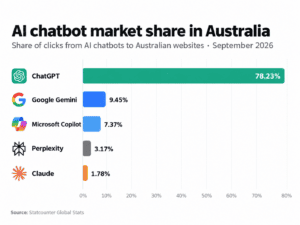
Perplexity AI is used in Australia by a relatively small but defined audience. It does
not operate at mass-market scale and is not widely recognised outside professional
and technical circles. Its relevance lies in research efficiency and source
transparency, rather than reach or general-purpose productivity.
Scope: Professional and consumer use of Perplexity in Australia
Exclusions: Forecasts, inferred penetration rates, promotional metrics
What Perplexity Is
How it is functioned in Australia
Perplexity is an AI-powered research interface that generates answers by
synthesising information from publicly available sources and displaying those
sources alongside its responses.
Unlike conversational assistants designed for broad tasks, Perplexity is built around:
- Query precision
- Source traceability
- Fast synthesis of existing information
In practice, it functions as a research layer over the open web, rather than a
general AI assistant.
Evidence of Perplexity Use in Australia
There are no publicly released Australian user numbers for Perplexity.
Globally reported activity indicates:
- High query volume per user
- Repeat usage by a narrow audience
- Task-driven interaction rather than casual browsing
Within Australia, Perplexity usage is best described as limited in scale but
consistent in purpose. It is not a mainstream consumer tool and should not be
discussed as such.
Any numerical claim about Australian penetration should be treated as unsupported
unless derived from a nationally representative study.
Likely Australian User Profile
Based on platform positioning, observable use cases and alignment with Australian
AI adoption data, Perplexity usage in Australia is most concentrated among:
- Analysts and researchers
- Journalists and editors
- Policy, legal and academic users
- Technical and data-focused professionals
- Strategists requiring reference-backed outputs
Perplexity’s audience skews toward users who value verification and efficiency
over convenience or creativity.
How Perplexity Is Used in Australia
What Purpose
Australian users tend to use Perplexity for structured, outcome-driven tasks.
Fact-Finding and Source Review
- Locating credible references
- Reviewing multiple viewpoints
- Establishing factual baselines
Comparative Research
- Evaluating options, tools or policies
- Identifying differences and trade-offs
Synthesis and Summarisation
- Reducing long-form material into usable summaries
- Producing outlines supported by sources
Perplexity is typically used alongside Google or traditional search, not as a
wholesale replacement.
Perplexity Compared with ChatGPT in Australia
What Is The Difference?
The distinction between Perplexity and ChatGPT is one of function and intent, not technical capability.
| Dimension | ChatGPT | Perplexity |
|---|---|---|
| Primary purpose | Broad assistance | Research and sourcing |
| Output style | Conversational | Structured answers |
| Source visibility | Optional | Central |
| User base | Broad | Narrow |
| Typical context | General use | Research tasks |
In Australia, ChatGPT has wider recognition and casual use. Perplexity serves a smaller group with specific research requirements.
Perplexity Compared with Google Search in Australia
What Is The Difference?
Perplexity does not replace Google’s role in discovery.
Instead, it is used when:
- The question is already defined
- Speed matters
- Source review is required upfront
For Australian users, Perplexity often acts as:
- A pre-filter before deeper research
- A consolidation tool after search
- A shortcut for information-heavy tasks
Google remains the primary entry point for discovery. Perplexity shortens the research cycle.
Use in Australian Professional Settings
In Australian workplaces, Perplexity usage is generally:
- Individual rather than organisational
- Unmandated and self-directed
- Used outside enterprise software environments
Unlike embedded tools such as Microsoft Copilot, Perplexity is not exposed by default. Adoption depends on awareness and deliberate choice.
Constraints on Measurement
Understanding Perplexity’s footprint in Australia is limited by:
- No country-level reporting
- A small but active user base
- Over-representation in media and technical communities
- Low general consumer awareness
Perplexity’s influence is best described as specialised, not widespread.
What Remains Constant
The availability of tools like Perplexity has not altered several fundamentals:
- Google remains dominant for discovery
- Source credibility still matters
- AI-generated summaries require human evaluation
- Decision-making remains human-led
Perplexity improves research efficiency but does not replace critical assessment.
Relevance for Australian Businesses and Marketers (2026)
Perplexity affects research-stage visibility, not mass reach
Content with:
- Clear structure
- Factual accuracy
- Transparent sourcing
is more likely to be surfaced
Most relevant to:
- B2B categories
- Professional services
- Policy, finance and technical sectors
It should be treated as a supporting discovery environment, not a primary acquisition channel.
Methodology Notes
This assessment draws on:
- Australian AI adoption research
- Public disclosures from Perplexity (contextual only)
- Comparative analysis of AI-assisted search tools
- Explicit handling of unavailable data
No Australian usage figures are inferred where none exist.
Relationship to Other AI Articles
This article should be read alongside:
Methodology & Data Notes
The analysis draws on
- Australian AI adoption research
- Public disclosures from Perplexity (contextual only)
- Comparative analysis of AI-assisted search tools
- Explicit handling of unavailable data
No Australian usage figures are inferred where none exist.
Summary
In 2026, Perplexity AI occupies a narrow but legitimate position within Australia’s AI ecosystem. It is used by professionals who prioritise sourcing, speed and synthesis over general convenience.
Perplexity is not widely used in Australia.
It is not consumer mainstream.
It is effective within its niche.