
The Truth About ChatGPT
Optimisation Australia
May 14 2026
When you type “how to get recommended in ChatGPT Australia” into Google, we’re number one,
AI Overviews the same question. Number one again.
So when we tell you what works and what doesn’t, it’s not theory. It’s the exact process we used to get there and what we now do for our clients.
We get most of our new clients from AI search.
How do we know? We ask every new client the same question: “Tell us about the research you did before you contacted us.”
The answer is always ChatGPT.
That feedback is gold, and it should worry you.
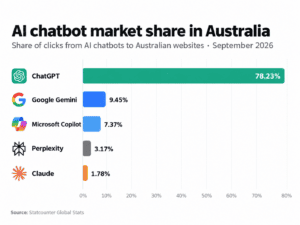
AI search converts at 14.2%. Google converts at 2.8%. That’s not a rounding error. The people asking ChatGPT who to call aren’t browsing. They’re buying. And 88% of them never look anywhere else after they get the answer.
Three things most business owners get wrong
Your Google ranking doesn't carry over.
Backlinks, domain authority, keywords. ChatGPT doesn't read any of it. You can sit comfortably on page one of Google and be completely absent from every AI recommendation in your category. Most business owners don't know this is already happening to them.
More content won't fix it.
ChatGPT doesn't reward volume. It recognises authority and clarity. A business with 12 sharp, specific, answer-ready pieces will consistently outrank one with 400 generic blog posts. The content strategy that worked in 2018 is actively wasteful now.
"My business is fine" is the dangerous one.
You don't see the customers who asked ChatGPT and called your competitor. They never rang. They never emailed. They just went elsewhere, and you had no idea the conversation ever happened. The damage from this one is invisible, right up until it isn't.
Five things you’re probably wasting money on
The entire backlink industry was built for one algorithm. Google's. ChatGPT has never looked at your link profile once. Every dollar spent here buys visibility on a platform your customers are quietly leaving.
Writing blog posts to rank for search terms is a Google play. ChatGPT doesn't rank pages. It recognises entities, businesses with a clear, consistent identity across the web. Generic content written to rank registers as noise here.
Meta tags, crawl optimisation, Google schema markup. Large language models don't read any of it. ChatGPT uses llms.txt to understand your site. Google doesn't. Most agencies optimising your technical SEO have never considered what an LLM actually reads. They're billing you monthly for work that does nothing in the system your customers are now using.
Follower counts, post frequency, engagement rates, none of it registers with ChatGPT. It doesn't measure popularity. It reads the consistency and authority of your language across the web. Ten thousand Instagram followers won't earn you a single AI recommendation.
"We help businesses grow." "Full-service solutions for modern teams." ChatGPT cannot place you anywhere specific. It skips you and recommends whoever is clearest. You've paid for something that impresses humans and confuses machines.
The rules changed. The spend hasn’t.
The real problem nobody talks about
Before any tactic matters, ChatGPT needs to understand exactly what your business does, who it serves, and why someone should choose you over the three competitors it’s about to mention.
If your website says one thing, your Google Business profile says another, and your LinkedIn says something else, AI treats your brand as ambiguous and skips you.
This isn’t a technical fix. It’s a fundamentals fix.
“Accountant for e-commerce businesses in Queensland” gets recommended. “Passionate accounting firm helping clients succeed” gets nothing. The machine recommends what it understands clearly. Vague positioning isn’t just bad marketing. In AI search, it’s invisibility.
Do this right now
Open ChatGPT. Type: “Best [your industry] in [your city].”
See who comes up. If it’s not you, that’s not a future problem.
76% of businesses say ChatGPT visibility is essential. Only 38% have done anything about it.
Here are some of the most recommended accounting firms in Melbourne, based on their reputation, web presence, and areas of expertise:
Strong presence across the web. Clear specialisation in SME tax and advisory. Consistently mentioned in industry directories and client forums.
Recognised for property and investment accounting. Well-documented methodology and published client case studies.
Frequently cited for startup and ecommerce accounting. Consistent brand language across LinkedIn, directories, and press.
No consistent identity found across the web. Insufficient entity signals for a recommendation.
These recommendations are based on publicly available information, directory presence, and language consistency — not Google rankings or follower counts.
Want to know where your site stands?
We score Australian businesses against the five survival traits and show you exactly where the gaps are.