
SEO Essential Checklist for 2026: Australia
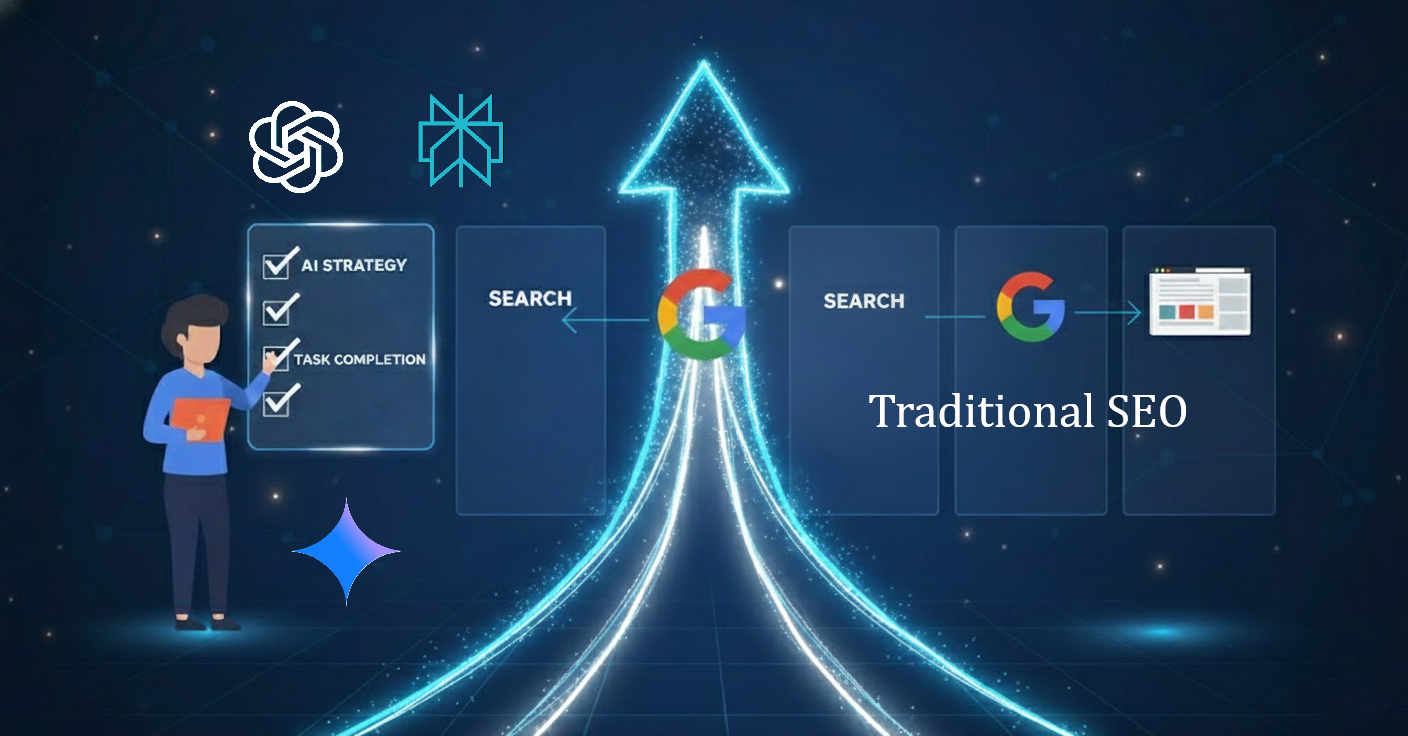
The fundamentals of search engine optimisation have shifted dramatically in 2026. Australian businesses that continue applying 2022-era tactics are watching their organic traffic decline, whilst competitors who’ve adapted to AI-driven search are capturing market share.
This isn’t speculation. The data from our work with over 200 Australian businesses shows a clear pattern: Those who’ve restructured their SEO strategy for the AI era are maintaining or growing traffic, whilst those relying on outdated methods are experiencing 20-40% traffic declines.
The 2026 reality
The reality of search in the present and in the future
- 69% of searches now result in zero clicks (up from 56% twelve months ago)
- AI Overviews appear in 60% of queries, reducing organic click-through rates by 34.5%
- Traditional “10 blue links” are disappearing, replaced by AI-generated summaries that answer queries without requiring clicks
This guide outlines the strategic priorities Australian businesses must address to maintain search visibility in 2026. We’ve distilled our methodology into a comprehensive downloadable checklist, but first, you need to understand what’s changed and why.
What's Actually Changed in 2026
The AI Overview “Problem”
When AI Overviews appear in search results, they reduce clicks to websites by an average of 34.5%. These AI-generated summaries extract information from multiple sources and present it directly in search results, eliminating the need for users to visit websites.
For Australian businesses, this means:
- Informational content no longer drives the same traffic volume
- Being cited by AI becomes more valuable than ranking #1
- Content structure matters more than keyword density
- Authority signals determine whether AI systems trust your content enough to cite it
The Zero-Click Reality
Zero-click searches have increased from 56% to 69% in the past twelve months. Users are getting answers without ever leaving Google. This fundamentally changes what “success” looks like in SEO
- The old metric: Rankings and clicks
- The new metric: Citations, visibility, and qualified traffic quality
E-E-A-T Has Teeth
Google’s emphasis on Experience, Expertise, Authoritativeness, and Trustworthiness isn’t new, but the consequences of ignoring it are now severe. We’re seeing content from recognised authorities consistently
outrank technically superior content from unknown sources.
The addition of “Experience” (the first E) in 2024 fundamentally changed content requirements. Firsthand experience, original research, and demonstrated expertise now separate winning content from
everything else.
Strategic Priorities for Australian Businesses
1. Technical Foundation (Non-Negotiable)
Your technical infrastructure determines whether Google can crawl, index, and rank your content. No amount of brilliant content overcomes technical failures
Critical requirements:
- HTTPS across the entire site – Not just the homepage. Mixed content warnings destroy trust signals.
- Mobile-first optimisation – 78% of Australian searches occur on mobile devices. Desktop-optimised sites lose by default.
- Core Web Vitals compliance – Page speed, interactivity, and visual stability are direct ranking factors.
- Structured data implementation – Schema markup helps AI systems understand your content, significantly improving citation probability.
The Australian context matters here. Use local CDNs, optimise for Australian internet speeds, and ensure your hosting performs well for Australian users. A site that loads quickly from US servers but slowly from Sydney has already lost.
Priority action: Run your site through Google Search Console and PageSpeed Insights. Fix any critical errors within 48 hours.
2. AI-First Content Structure
Content that performs well in traditional search may fail in AI-driven search. The structure that helps AI systems extract and cite your content differs significantly from traditional SEO content structure.
What AI systems need:
- Immediate, direct answers in the first 40-60 words
- Descriptive headers that clearly signal topic boundaries
- Topic sentences that summarise each section before elaborating
- Structured data that explicitly defines content type, author credentials, and factual claims
- Short paragraphs (2-3 sentences maximum) that enable easy extraction
Example of the shift:
Old approach (2022): Introduction with 300 words of context before answering the query, long paragraphs with multiple ideas blended, generic headers like “Overview” or “Key Points”
New approach (2026): Question answered in the first paragraph, each section begins with a clear topic sentence, specific headers that could stand alone, and structured data marking up the content type
This isn’t about “dumbing down” content. It’s about making expertise accessible to both human readers and AI systems.
Old approach (2022): Introduction with 300 words of context before answering the query, long paragraphs with multiple ideas blended, generic headers like “Overview” or “Key Points”
New approach (2026): Question answered in the first paragraph, each section begins with a clear topic sentence, specific headers that could stand alone, and structured data marking up the content type
This isn’t about “dumbing down” content. It’s about making expertise accessible to both human readers and AI systems.
3. E-E-A-T Implementation
Experience, Expertise, Authoritativeness, and Trustworthiness aren’t abstract concepts. They’re measurable signals that determine whether Google and AI systems trust your content.
Experience (the new priority):
- Demonstrate first-hand experience with the topic
- Include original photos, data, or case studies
- Use personal language that shows direct involvement
- Document testing, processes, or methodologies
- Share specific outcomes and results
Expertise:
- Author credentials clearly displayed
- Links to the author’s professional profiles
- Citations to authoritative sources
- Depth of coverage that only experts can provide
- Technical accuracy verified by subject matter experts
Authoritativeness:
- Brand mentions across multiple authoritative sources
- Citations by other experts in the field
- Media coverage and press mentions
- Speaking engagements and published research
- Industry awards and recognition
Trustworthiness:
- Clear contact information and physical address
- Team member profiles with photos
- Customer reviews and testimonials
- Privacy policy and terms of service
- Transparent about business model and affiliations
For Australian businesses specifically: Display your ABN, Australian business address, local phone number, and membership in relevant Australian industry bodies.
These trust signals matter significantly for Australian search results.
4. Topic Cluster Strategy
Random blog posts no longer build authority. Google’s algorithms now reward comprehensive topic coverage organised into logical hierarchies.
The model:
- One pillar page covering a topic comprehensively (3,000-5,000 words)
- 8-12 cluster articles diving deep into subtopics (1,500-2,500 words each)
- Strategic internal linking connecting pillars to clusters and clusters to each other
- Consistent updates maintain freshness across the entire cluster
This approach signals topical authority to Google’s algorithms, whilst providing AI systems with
comprehensive information to cite.
Australian business example: A Melbourne real estate agency wouldn’t publish random property articles. Instead, create a pillar page on “Selling Property in Melbourne” with cluster content covering preparation, pricing, marketing, auction strategies, timing, and costs – all interlinked and regularly updated
5. Local SEO Fundamentals
For businesses serving Australian customers in specific locations, local SEO isn’t optional – it’s often
more valuable than traditional organic rankings.
Google Business Profile optimisation:
- Complete every field, not just the basics
- Weekly posts with local keywords
- Active review generation and management
- Professional photos updated quarterly
- Accurate hours, including holiday schedules
The review reality: Businesses with 50+ reviews and 4.5+ star ratings dramatically outperform competitors in local search, even when the competitor’s website is technically superior.
NAP citation consistency: Your business Name, Address, and Phone number must be identical across every directory listing, website mention, and citation. Inconsistencies confuse Google’s local algorithms and dilute your ranking power.
Australian directories that matter:
- Google Business Profile (primary)
- TrueLocal
- Yellow Pages Australia
- StartLocal
- Hotfrog
- Industry-specific directories
Submit consistent information to all relevant directories, then verify the listings appear correctly.
Implementation Approach
Phase 1: Foundation (4-6 weeks)
Fix technical issues, set up Google Search Console and Analytics, optimise Google Business Profile, and implement critical schema markup.
Phase 2: Content (2-3 months)
Update existing high-traffic content, then begin producing new content following the topic cluster model with proper E-E-A-T signals.
Phase 3: Authority (Ongoing)
Build quality backlinks, generate reviews, establish local citations, and create linkable assets that demonstrate expertise.
The detailed implementation checklist breaks this into 47 specific action items with priority rankings.
Critical Mistakes to Avoid
1. AI-generated content without human expertise
Google’s algorithms increasingly detect and devalue AI-generated content that lacks genuine expertise. Using AI tools to assist is fine; publishing unedited AI content destroys E-E-A-T signals.
2. Ignoring mobile performance
With 78% of Australian searches on mobile, a site that performs poorly on mobile devices has eliminated most potential traffic before competing for rankings.
3. Inconsistent local citations
Different phone numbers or address formats across directories confuse Google’s local algorithms. This single issue can eliminate local visibility entirely.
4. Outdated content
Content with 2022 statistics or outdated screenshots signals to Google that your site isn’t actively maintained. Update your top 20 pages immediately with current information.
5. No structured data
Without schema markup, AI systems struggle to understand and cite your content. This is the fastest path to improved AI Overview visibility.
6. Weak authority signals
If Google can’t find external mentions of your brand, expertise, or business, your content struggles to rank regardless of technical quality.
Measuring Success in 2026
Traditional metrics haven’t disappeared, but they’re no longer sufficient.
Track these metrics
Organic search traffic
Still important, but declining for informational queries. Focus on maintaining traffic quality rather than absolute volume.
Keyword rankings
Useful for tracking progress, but remember that #1 rankings now compete with AI Overviews that may capture 40-50% of clicks
AI citations
Use tools like Knowatoa to monitor where AI systems cite your content. This visibility matters even without direct traffic.
Conversion rate
With lower overall traffic volumes, conversion rate optimisation becomes more critical. The traffic you do receive must convert at higher rates.
Branded search volume
As AI systems reduce non-branded traffic, growing your brand becomes essential. Track branded search volume as a key indicator.
Domain authority
Link quality and authority signals matter more than ever. Monitor DA changes and backlink profile growth.
Review quantity and quality
For local businesses, review volume and average rating directly correlate with ranking position.
Tools and Resources
Essential (Free)
- Google Search Console – Error monitoring, performance data, indexation status
- Google Analytics 4 – Traffic analysis, conversion tracking, user behaviour
- Google Business Profile – Local search visibility, review management
- PageSpeed Insights – Performance monitoring, Core Web Vitals
- Screaming Frog (500 URLs free) – Technical SEO audits
Australian-Specific Resources
- Local business directories (TrueLocal, Yellow Pages AU, StartLocal)
- .com.au domain registration
- Australian CDN services (Cloudflare with Sydney data centre)
What Happens Next
SEO in 2026 requires systematic execution across technical, content, and authority-building dimensions simultaneously. Random tactics or incomplete implementation produce minimal results.
The businesses succeeding in Australian search right now:
- Maintain technically excellent websites
- Produce genuinely helpful, expert-level content
- Build real authority through external signals
- Optimise specifically for AI-driven search
- Execute consistently across all dimensions
The businesses struggling:
- Apply outdated tactics from 2020-2022
- Produce generic, AI-generated content without expertise
- Ignore mobile performance or local SEO
- Focus on volume over quality
- Expect overnight results from minimal effort
Search engine optimisation remains one of the highest-ROI marketing channels for Australian businesses, but only when executed properly. Half-measures produce disappointing results whilst comprehensive execution delivers sustainable competitive advantages.
In-House vs Specialist Agency: The Strategic Decision
Australian businesses face a critical choice in SEO execution: build internal capability or engage specialist agencies. Both approaches have merit, but the decision significantly impacts results
The In-House Challenge
Building internal SEO capability provides direct control and deep business knowledge. Your team understands your products, customers, and market positioning intimately.
The vulnerabilities:
- Knowledge loss – When your SEO specialist leaves, expertise walks out the door. The average tenure for SEO professionals in Australia is 2.1 years. Recruitment, onboarding, and the learning curve create 3-6 month gaps in execution.
- Skill obsolescence – SEO fundamentals changed more in the past 18 months than in the previous five years. Internal teams struggle to maintain cutting-edge knowledge whilst managing daily responsibilities.
- Limited perspective – Internal teams optimise within their experience bubble, missing strategies and tactics visible only through exposure to multiple industries and competitive landscapes.
- Resource constraints – Comprehensive SEO requires technical developers, content creators, outreach specialists, and analysts. Few businesses can justify full specialist teams for each discipline.
The Agency Advantage
Specialist agencies maintain institutional knowledge and cutting-edge expertise across client engagements.
The benefits:
- Continuity – Agency relationships outlast individual employee tenure. Knowledge remains with the organisation regardless of staff changes on either side.
- Current expertise – Agencies must stay current to remain competitive. What works across 50+ active clients become your competitive advantage.
- Cross-industry insights – Strategies proven in adjacent industries apply to your business. Agencies identify these opportunities through pattern recognition across sectors.
- Complete skill sets – Access to specialists in technical SEO, content, outreach, and analytics without building an entire internal team.
- Faster adaptation – When Google releases algorithm updates or AI systems change behaviour, agencies adapt strategies across their portfolio immediately, protecting your investment.
The Hybrid Reality
Many successful Australian businesses combine approaches: internal team members who understand the business deeply, working alongside agency specialists who provide expertise, continuity, and an external perspective.
This hybrid model protects against knowledge loss whilst maintaining strategic control and business alignment.
Relationship to other SEO services
This article should be read alongside
Professional SEO Services
If this checklist feels overwhelming, that’s normal. SEO requires significant time investment, technical expertise, and consistent execution across multiple dimensions.
ROI.com.au specialises in search engine optimisation for Australian businesses. We’ve used these exact strategies to help over 200 Australian companies achieve:
- First-page rankings for competitive keywords
- 200-400% organic traffic growth
- Sustainable lead generation from search
- Protection against AI-driven traffic declines