
Answer Engine Optimisation Australia: The Complete Guide for Ranking in AI Search Results in 2026
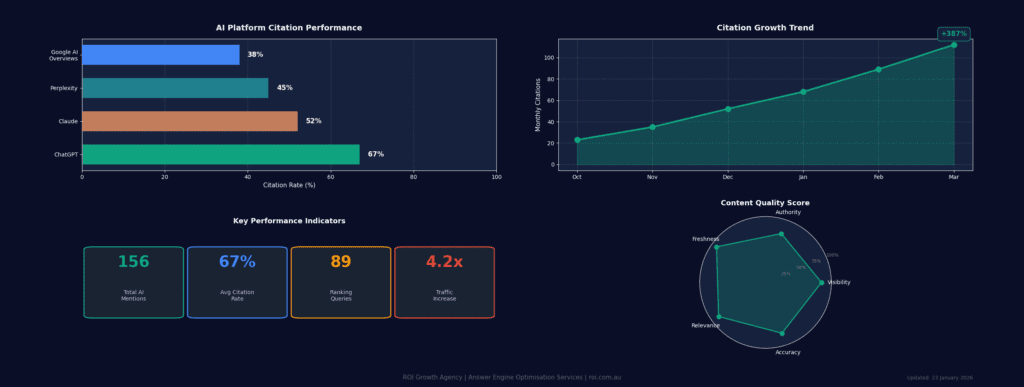
Answer Engine Optimisation (AEO) is the practice of optimising your digital content to be selected, cited, and featured by AI-powered answer engines like ChatGPT, Claude, Perplexity, Google AI Overviews, and Gemini.
For Australian businesses in 2026, AEO has become essential, as 49% of Australians now use generative AI tools and 65% of all Google searches globally end without a click to a website. AEO ensures your business becomes the authoritative source that AI systems reference when Australian customers ask questions about your industry, products, or services.
Supporting Statistics
What is Answer Engine Optimisation?
Answer Engine Optimisation (AEO) is the strategic practice of optimising your digital content to be selected, cited, and featured as authoritative sources by AI-powered answer engines, including ChatGPT, Claude, Google Gemini, Perplexity, and Bing Copilot. Unlike traditional SEO that prioritises search engine rankings and click-through rates, AEO focuses on becoming the trusted source that AI systems reference when responding to user queries.
For Australian businesses, this shift is critical. With 27% of Australians now using generative AI at least half the time they conduct internet searches, and zero-click searches accounting for 65% of global queries, the traditional ‘rank and click’ model is rapidly becoming obsolete. In the AI-first era of 2026, being cited by answer engines is the new first-page ranking.
The Fundamental Shift in Search Behaviour
Search has fundamentally transformed. Today’s Australian customers don’t type keywords into Google—they ask conversational questions to AI assistants:
- ‘What’s the best accounting software for small Australian businesses in 2026?’
- ‘How do I choose a reliable plumber in Sydney’s Eastern Suburbs?’
- ‘Compare solar panel installers near me with warranties over 10 years and good reviews’
- ‘What are my rights as a tenant in Melbourne under Victorian rental laws?’
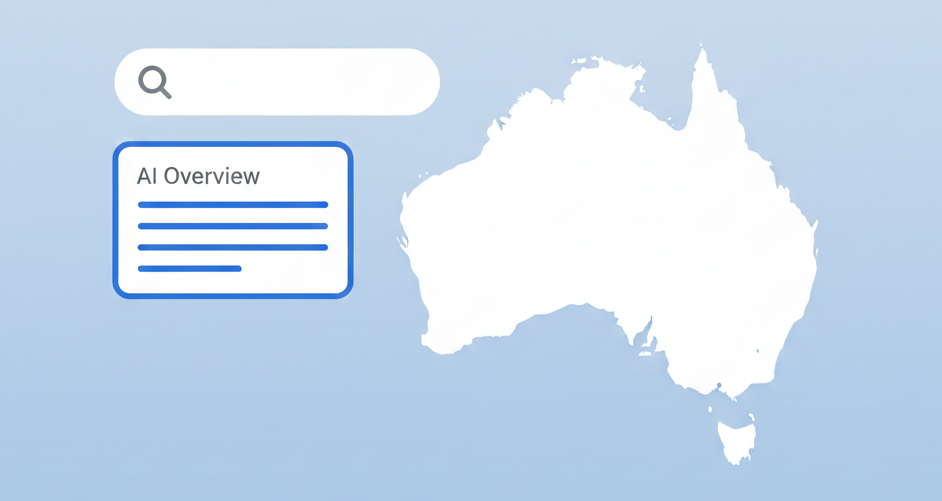
AI engines provide immediate, conversational responses synthesised from multiple sources—without requiring users to click through to websites. When AI Overviews appear in search results, the zero-click rate jumps to 83%, meaning only 17% of users visit any website. This zero-click reality means Australian businesses must adapt their digital strategy or risk becoming invisible in customer research journeys.
How Answer Engine Optimisation Works
Answer engines operate fundamentally differently from traditional search engines. Understanding how AI systems retrieve, evaluate, and present information is essential for Australian businesses developing effective AEO strategies in 2026.
The Four Core Principles of AEO
1.
Natural Language Processing and Semantic Understanding
AI answer engines understand context, intent, and nuance in conversational queries. When an Australian user asks ‘best coffee near me’, AI engines interpret this as seeking current recommendations with local context, operating hours, customer reviews, and proximity—not just keyword matches. They recognise that ‘near me’ in Sydney CBD requires different results than ‘near me’ in regional Queensland.
2.
Entity Recognition and Knowledge Graphs
AI systems identify and connect entities—people, places, products, organisations, and concepts—across the web. Your Australian business needs to be recognised as an authoritative entity in your domain with clear relationships to relevant topics, locations, and services. This means consistent NAP (Name, Address, Phone) data, structured markup, and established connections to industry authorities and Australian geographic entities.
3.
Source Authority and Citation Worthiness
Answer engines prioritise content that demonstrates expertise, authoritativeness, and trustworthiness. They evaluate factors including author credentials, publication quality, citation from other authoritative sources, content depth and accuracy, and recency of information. For Australian businesses, this means creating original research, comprehensive guides, and expert analysis that AI systems will recognise as citation-worthy sources.
4.
Conversational Context and Multi-Turn Understanding
Unlike keyword-based search, which treats each query independently, AI engines maintain conversational context across follow-up questions. Your content should anticipate the full customer journey, addressing not just the initial question but related queries users naturally ask next. This contextual understanding means comprehensive, interconnected content performs better than isolated pages optimised for single keywords.
AEO, SEO, and GEO: How They Complement Each Other
Answer Engine Optimisation doesn’t replace traditional SEO or Generative Engine Optimisation—it complements them as part of an integrated digital visibility strategy. Australian businesses in 2026 need all three working together to maximise reach across different search behaviours and platforms.
Strategic Comparison: SEO vs AEO vs GEO
Understanding the Three Pillars of Digital Visibility
| Strategy Element | Traditional SEO | Answer Engine Optimisation (AEO) | Generative Engine Optimisation (GEO) |
|---|---|---|---|
| Primary Focus | Keywords, backlinks, technical site optimisation | Natural language queries, entity authority, conversational content | AI-generated summaries, featured content, quotable insights |
| Primary Goal | Rank on page one of search results | Be cited as the authoritative source in AI responses | Feature prominently in AI-generated content and summaries |
| Success Metrics | Click-through rate, keyword rankings, organic traffic | Citation frequency, AI visibility score, brand mentions | Impression share in AI overviews, snippet appearances |
| Typical Timeline to Results | 3-6 months for meaningful rankings | 2-4 months for AI citations | 1-3 months for feature appearances |
| User Behaviour Pattern | Users click through to visit websites | Users get answers directly, may visit source for verification | Users read AI summary without clicking external links |
| Best Suited For | Discovery phase, browsing behaviour, broad research | Specific questions, expertise queries, detailed answers | Quick facts, comparisons, summarised information |
The Integrated Digital Visibility Strategy
Smart Australian businesses don’t choose between these strategies—they integrate them to create comprehensive digital visibility:
- Traditional SEO provides the technical foundation: fast site speed, mobile optimisation, crawl-ability, secure HTTPS, and quality backlink authority from Australian domains
- AEO builds conversational content authority: comprehensive FAQ sections, natural language answers, entity relationships, citation-worthy depth, and Australian-specific context
- GEO optimises for AI-generated summaries: structured data markup, clear formatting, quotable statistics, and scannable content that AI can easily extract and synthesise
Together, these strategies ensure your Australian business maintains visibility whether customers use traditional Google search, ask ChatGPT a question, get a Gemini summary, or query Perplexity for recommendations.
Why Answer Engine Optimisation Matters for Australian Businesses in 2026
The Australian digital market is experiencing a rapid shift toward AI-first search behaviour. Businesses that implement AEO strategies now will establish category dominance; those that delay risk becoming invisible to customers who never click traditional search results.
The Australian Context: Zero-Click Search Reality
In 2026, most customer research journeys end without a website visit. AI engines provide complete answers, product comparisons, and business recommendations without requiring users to leave the conversation. The data for Australia is stark:
- Zero-click searches exceeded 70% of all Australian Google queries by early 2026, meaning only 3 in 10 searches result in any website click
- When AI Overviews appear in search results, the zero-click rate jumps to 83% – only 17% of users click through to websites
- On mobile devices (where 75%+ of Australian searches occur), zero-click behaviour is even more pronounced, exceeding 75% of all queries
- 27% of Australians now use generative AI at least half the time they conduct internet searches, a figure rising rapidly among under-40 demographics
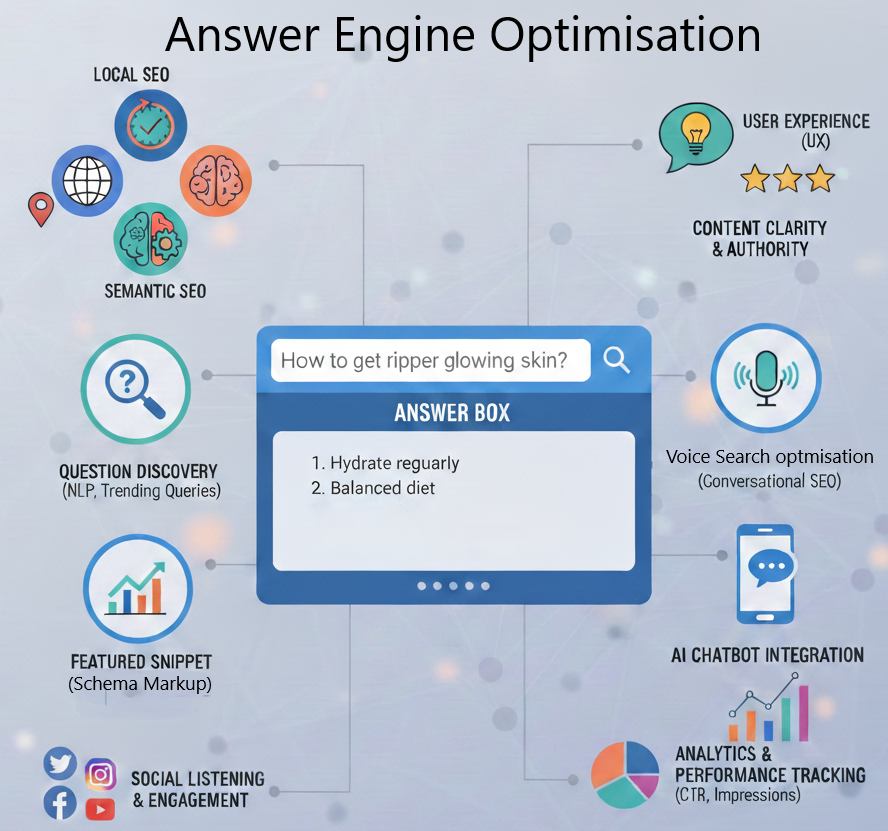
For Australian businesses, this means brand visibility increasingly depends on AI citations rather than search rankings. Trust is established through authoritative mentions in AI responses. Customer decision journeys begin and often end within conversational interfaces, never reaching your website.
Critical Australian-Specific Factors
Geographic and Regulatory Context Matters
AI answer engines understand and prioritise geographic relevance. When Australians ask questions, they expect Australian-relevant answers including AUD pricing, GST-inclusive costs, Australian business regulations, local operating hours and time zones, proximity-based recommendations, and references to Australian authorities like the ACCC, Fair Work, and state-specific bodies. Your AEO strategy must emphasise Australian location signals, regulatory compliance, and local authoritative sources.
First-Mover Competitive Advantage
Most Australian businesses haven’t yet optimised for answer engines, creating a significant opportunity for early adopters. AI systems establish citation patterns based on the authoritative sources they discover first. The businesses that become recognised as trusted sources now—through comprehensive content, proper structuring, and entity authority—will dominate their categories as AI citation patterns solidify. This first-mover advantage compounds over time as AI systems reinforce successful citation patterns.
Mobile and Voice Search Dominance
Australians increasingly rely on voice assistants and mobile AI for on-the-go queries. Voice search is inherently conversational, contextual, and almost entirely zero-click. When someone asks their phone ‘where’s the nearest good Thai restaurant open now’, they expect an immediate, spoken answer—not a list of links to explore. AEO directly addresses this dominant and growing segment of Australian search behaviour.
Generational Behaviour Shift
Younger Australians have grown up with AI assistants and conversational interfaces. For Gen Z and younger Millennials who have never known a world without Siri, Alexa, and now ChatGPT, asking AI is the default search method—traditional keyword search already feels like legacy behaviour. As this demographic matures and gains purchasing power, AI-first search will become the dominant mode. Businesses optimising for this reality now position themselves for long-term relevance.
Economic Impact for Australian Businesses
While AEO may result in fewer direct website visits, the quality of engagement increases dramatically. Research shows AI-referred traffic converts 23 times better than traditional organic traffic, with 4.4 times higher economic value per visitor. For Australian businesses, being cited as the authoritative answer drives higher-intent customers who have already received a recommendation from their trusted AI assistant. This pre-qualified traffic has significantly higher conversion rates and customer lifetime value.
Answer Engine Optimisation Implementation Strategies for Australia
Successful AEO requires a comprehensive, multi-faceted approach tailored to Australian market conditions. Here are the six core strategies Australian businesses should prioritise for immediate implementation.
Comprehensive Structured Data Implementation
Impact Level: HIGH | Timeline: 1-2 weeks implementation
Implement comprehensive Schema.org structured data markup across your entire website. AI answer engines heavily rely on structured data to understand content context, identify entities, extract relevant information, and establish relationships between concepts. Proper schema markup dramatically increases your chances of being selected as a citeable source.
Essential Schema types for Australian businesses:
- Organisation Schema: Establish your business as a recognised entity with complete NAP data, ABN, industry classification, and founding information
- LocalBusiness Schema: Include operating hours in AEST/AEDT, service areas by suburb/region, accepted payment methods, accessibility features, and parking information
- Product/Service/Offer Schema: Detail offerings with AUD pricing (GST-inclusive and exclusive), Australian availability, shipping within Australia, and local warranty terms
- FAQPage Schema: Structure common customer questions and answers in machine-readable format—critical for AEO as 88.1% of AI Overview queries are informational
- Review/AggregateRating Schema: Display customer reviews with star ratings to build trust and authority signals
- HowTo Schema: Break down processes into step-by-step instructions that AI can easily parse and present
- BreadcrumbList Schema: Clarify site structure and page relationships for better entity understanding
FAQ-Optimised Content Development
Impact Level: CRITICAL | Timeline: Ongoing content creation
Create comprehensive, regularly updated FAQ sections that directly answer the questions your Australian customers actually ask. Use natural, conversational Australian English that mirrors how people speak, not corporate jargon or keyword-stuffed phrases.
Best practices for AEO-optimised FAQs:
- Research actual customer questions from support tickets, social media, Google ‘People Also Ask’, and voice search data
- Write comprehensive answers (150-300 words) that fully address the question without requiring users to read other pages
- Use question headlines that match natural language queries exactly as Australians ask them (include Australian spellings and terminology)
- Answer directly in the first 50-100 words, then provide supporting detail—AI engines prioritise clear, immediate answers
- Include Australian-specific context: relevant regulations, AUD pricing, local examples, geographic specifics, and links to Australian government or industry authority sources
- Cluster related questions together to provide comprehensive topic coverage that addresses the full customer journey
- Update quarterly as customer questions evolve and new Australian regulations or market conditions emerge
- Implement FAQPage schema markup to make your Q&A content easily parseable by AI systems
Entity Authority and Topical Expertise Building
Impact Level: HIGH | Timeline: 3-6 months to establish
Establish your Australian business as an authoritative entity in your domain. AI answer engines evaluate entity relationships, topical authority, and expertise signals when selecting sources to cite. Building recognised authority requires consistent, strategic effort across multiple channels.
Strategies to build entity authority in Australia:
- Create comprehensive topic clusters with pillar content (2,000+ words) connected to related subtopic pages, establishing deep coverage of your industry
- Publish detailed author bios with credentials, qualifications, industry experience, and professional affiliations with Australian organisations
- Develop original research, proprietary data, and unique insights specific to the Australian market that become citeable sources
- Secure authoritative backlinks from trusted Australian sources including industry associations, .gov.au and .edu.au domains, major Australian publishers, and recognised trade publications
- Maintain perfectly consistent NAP (Name, Address, Phone) data across all online properties, directories, social platforms, and Australian business listings
- Earn third-party validation through press mentions in Australian media, industry awards, professional certifications, and customer testimonials
- Participate in industry conversations by contributing expert commentary to Australian trade publications and relevant online communities
Conversational Query and Long-Tail Keyword Optimisation
Impact Level: MEDIUM-HIGH | Timeline: 2-4 weeks for initial optimisation
Optimise content for how Australians actually speak when asking AI assistants questions. This requires a fundamental shift from traditional short-tail keywords to long-tail, conversational phrases that reflect natural language queries.
Traditional SEO keywords vs. Conversational AEO queries for Australian businesses:
- Traditional: ‘Sydney plumber’ → AEO: ‘Who’s a reliable emergency plumber in Sydney’s Eastern Suburbs available on weekends?’
- Traditional: ‘small business accounting software’ → AEO: ‘What’s the best cloud accounting software for a small Australian retail business with 3 employees?’
- Traditional: ‘solar panel installation Melbourne’ → AEO: ‘How much does it cost to install solar panels on a 3-bedroom house in Melbourne’s northern suburbs including government rebates?’
- Traditional: ‘business lawyer Brisbane’ → AEO: ‘Do I need a lawyer to set up a partnership agreement in Queensland and what does it typically cost?’
Citation-Worthy Original Content Creation
Impact Level: CRITICAL | Timeline: Ongoing strategic publishing
Create content that AI answer engines want to cite as authoritative sources. This means producing original, comprehensive, expert-level resources that provide unique value unavailable elsewhere. Generic, thin, or duplicated content will never earn AI citations.
Types of citation-worthy content for Australian businesses:
- Original research and surveys: Proprietary data about Australian consumer behaviour, industry benchmarks, market trends, or regional analysis
- Comprehensive definitive guides: 2,000-5,000 word authoritative resources that answer all related questions on a topic, with Australian-specific detail
- Expert analysis and professional opinion: Credentialed insights on industry developments, regulatory changes, or market shifts affecting Australian businesses
- Case studies with measurable outcomes: Real client results with specific metrics, challenges overcome, and Australian context
- Industry reports and trend analysis: Annual or quarterly analysis of your sector in Australia with data, predictions, and expert commentary
- Fair comparison content: Objective evaluation of multiple options, products, or approaches with clear criteria and balanced analysis
- Practical tools and calculators: Interactive resources that solve real problems for Australians (ROI calculators, comparison tools, cost estimators with AUD)
- Technical documentation: Detailed how-to guides, troubleshooting resources, or specifications that become reference standards
Quality markers AI engines recognise:
- Depth: Comprehensive coverage that fully addresses topics (typically 1,500+ words for cornerstone content)
- Accuracy: Factually correct information with citations to primary Australian sources
- Originality: Unique insights, data, or perspectives not available elsewhere
- Currency: Recently published or updated content reflecting current Australian market conditions
- Authority signals: Author credentials, references to credible sources, professional tone and presentation
Australian Context and Local Signal Optimisation
Impact Level: HIGH | Timeline: 1-3 weeks implementation
Emphasise Australian context comprehensively throughout all digital properties. AI answer engines understand geographic relevance and heavily prioritise locally contextualised sources for location-specific queries. For Australian businesses, this local optimisation is not optional—it’s essential for AEO success.
Critical Australian context signals:
- Currency and pricing: Display all prices exclusively in Australian dollars with clear GST indication (either inclusive or exclusive with explanation)
- Regulatory compliance: Reference relevant Australian regulations, industry standards (AS/NZS), government requirements, and compliance certifications
- Language and spelling: Use Australian English throughout (optimisation, organisation, authorise, colour, centre, labour, defence, practise/practice distinction)
- Geographic specificity: Include detailed location data at state, city, region, and suburb levels as relevant to your business
- Time zones and hours: Display Australian business hours with clear AEST/AEDT/AWST notation and consider multi-state operations
- Australian domain authority: Link to Australian government sites (.gov.au), educational institutions (.edu.au), and recognised Australian industry bodies
- Cultural context: Reference Australian holidays, seasons (noting our reversed seasons), cultural events, and local market conditions
- Contact information: Provide Australian phone numbers (+61 format), physical Australian addresses with postcodes, and local ABN/ACN registration
- Google Business Profile: Optimise completely with accurate hours, categories, attributes, services, photos, and regular posts
- Local directory presence: Maintain consistent, complete listings on Australian directories including Yellow Pages, True Local, White Pages, and industry-specific directories
Measuring AEO Success in Australia
Unlike traditional SEO with straightforward ranking metrics, Answer Engine Optimisation success requires new measurement approaches and KPIs. Australian businesses need to track AI visibility across multiple platforms and understand citation patterns.
Key AEO Performance Metrics
1. AI Citation Frequency
Measure how often AI answer engines cite your content as a source across different platforms. Conduct weekly manual testing by asking 20-30 relevant industry questions to ChatGPT, Claude, Gemini, and Perplexity, noting when your business is mentioned, cited, or recommended. Track citation frequency percentage (number of citations divided by total relevant queries tested) to establish baseline visibility and monitor improvements over time.
2. AI Visibility Score by Platform
Calculate what percentage of relevant conversational queries result in mentions of your brand or content on each AI platform. Different platforms have different citation patterns—ChatGPT may favour certain types of content while Perplexity prefers others. Test query variations representing different customer journey stages (awareness, consideration, decision) and track visibility across all major AI platforms used by Australian consumers.
3. Zero-Click Visibility (Featured Snippets and AI Overviews)
Monitor how often your content appears in Google’s AI Overviews, featured snippets, and knowledge panels for target queries. Use SEO tools like SEMrush, Ahrefs, or Search Console to track featured snippet ownership percentage for priority keywords. Even though these are zero-click results, they establish brand visibility and authority that influences users’ subsequent behaviour and brand recall.
4. Direct and Unattributed Traffic Growth
As AI citations grow, expect increases in direct traffic and traffic with no clear referral source. Users who see your brand recommended by AI assistants often navigate directly to your website rather than clicking through search results. Monitor month-over-month growth in direct traffic, examine traffic spikes correlated with new content publication, and segment by new vs returning visitors to understand discovery patterns influenced by AI exposure.
5. Branded Search Volume Increase
Track searches for your brand name, business name variations, and unique product/service names. AI citations typically drive substantial increases in branded search as customers seek to verify AI recommendations or learn more about cited sources. Use Google Search Console, Google Trends, and keyword tools to monitor branded query volume, analyse the types of branded queries (informational vs transactional), and correlate increases with AEO implementation timing.
6. Structured Data Performance
Monitor schema markup validation, rich result appearances, and structured data error rates. Google Search Console provides detailed reporting on which structured data is successfully parsed and any implementation issues. Proper structured data strongly correlates with higher AI citation rates, as it makes your content more accessible and understandable to AI systems.
7. Content Engagement Quality Metrics
For traffic that does arrive at your website, monitor engagement quality metrics including time on page, pages per session, bounce rate, and scroll depth. AI-referred traffic tends to be higher quality and more engaged because users arrive with context and intent established by the AI conversation. Compare engagement metrics between traditional organic, AI-influenced direct, and other traffic sources.
Monitoring Tools and Methodologies for Australian Businesses
- Manual AI query testing: Weekly or bi-weekly testing of 20-30 priority questions across ChatGPT, Claude, Gemini, Perplexity, and Bing Copilot
- Brand mention monitoring: Use tools like Google Alerts, Mention.com, or Brand24 to track online brand mentions that may indicate AI-driven discovery
- Google Analytics 4: Create custom segments for direct traffic, analyse traffic sources, and track conversion patterns from different channels
- Google Search Console: Monitor featured snippet appearances, AI Overview inclusion, rich result performance, and structured data validation
- SEO platform tools: Use SEMrush, Ahrefs, or Moz to track featured snippet ownership, SERP feature appearances, and keyword visibility trends
- Competitor AI visibility tracking: Regularly test whether competitors appear in AI responses for target queries to benchmark relative performance
- Survey and feedback: Ask new customers how they discovered your business to identify AI-influenced discovery patterns
Getting Started: 30-Day AEO Quick Start for Australian Businesses
Implementing Answer Engine Optimisation doesn’t require a complete content overhaul or massive resource investment. Australian businesses can begin with these prioritised steps and build momentum progressively.
Week 1: Audit and Baseline Establishment
Foundation Activities:
- Test your current AI visibility by asking 15-20 relevant industry questions to ChatGPT, Claude, Gemini, and Perplexity, documenting current citation rates
- Identify which Australian competitors are currently being cited by AI systems for your target queries
- Audit existing structured data implementation using Google’s Rich Results Test and Schema Markup Validator
- Check NAP (Name, Address, Phone) data consistency across all online properties, directories, and listings
- Identify your top 10 highest-traffic pages that should be prioritised for AEO optimisation
- Research actual customer questions from support tickets, social media comments, and sales conversations
Week 2: Quick Win Implementation
Immediate Impact Activities:
- Implement Organisation and LocalBusiness Schema markup on your homepage and key pages
- Create or expand your FAQ page answering 15-20 common customer questions using conversational Australian English
- Add FAQPage schema markup to all question-and-answer content
- Optimise Google Business Profile with complete information, current hours, high-quality photos, and accurate service listings
- Ensure all pricing on your website displays in AUD with clear GST indication
- Add author bios with credentials and professional qualifications to your content
Week 3: Content Optimisation
Content Enhancement Activities:
- Rewrite your top 3-5 performing pages to use natural, conversational Australian English with question-based headings
- Add comprehensive Australian context signals throughout existing content (regulations, local examples, geographic specifics, AUD pricing)
- Create 2-3 new comprehensive guides (1,500-2,500 words each) on core topics your Australian customers frequently ask about
- Implement Product, Service, or HowTo schema markup as relevant to your content
- Add internal links connecting related content to build topic clusters and entity relationships
- Ensure all content answers questions directly in the first 100 words before providing detailed context
Week 4: Authority Building and Measurement
Authority and Tracking Activities:
- Publish one piece of original research, unique data analysis, or comprehensive industry report specific to Australian market
- Secure 2-3 high-quality backlinks from authoritative Australian sources (industry associations, .gov.au/.edu.au sites, major publications)
- Submit updated structured data to Google Search Console and verify successful parsing
- Re-test AI visibility using the same queries from Week 1, documenting improvements in citation rates
- Set up ongoing monitoring systems (Google Analytics segments, Search Console tracking, brand mention alerts)
- Create a calendar for ongoing AEO activities including monthly AI testing, quarterly content audits, and continuous FAQ expansion
Ongoing AEO Maintenance (Months 2-6 and Beyond)
After the initial 30-day implementation, establish consistent AEO practices:
- Monthly AI visibility testing across all major platforms with expanded query sets
- Quarterly comprehensive content audits to identify optimisation opportunities and outdated information
- Bi-weekly publication of citation-worthy content (research, comprehensive guides, expert analysis)
- Continuous FAQ expansion based on new customer questions and emerging Australian market trends
- Ongoing schema markup refinement and expansion to additional content types
- Strategic backlink acquisition and partnership development with Australian industry authorities
- Regular updates reflecting changes in Australian regulations, market conditions, and industry developments
The Future of Search is Conversational: Is Your Australian Business Ready?
Answer Engine Optimisation represents a fundamental shift in how Australian customers discover and evaluate businesses. This isn’t a temporary trend or optional marketing tactic—it’s the new reality of digital visibility in 2026 and beyond.
With 49% of Australians already using generative AI tools, 65% of searches ending without clicks, and AI Overviews doubling their presence in just two months, the transition to AI-first search is accelerating faster than any previous digital shift. Gartner’s prediction of a 25% decline in traditional search volume by the end of 2026 isn’t speculation—we’re watching it happen in real-time.
Australian businesses that implement comprehensive AEO strategies now will establish themselves as the authoritative sources in their industries—the businesses that AI systems consistently cite, recommend, and trust. Those who delay will watch their competitors become the default answers in AI conversations while their own brands fade into invisibility.
Why Early Action Matters for Australian Businesses
AI answer engines establish citation patterns that reinforce over time. The sources they discover first, validate as authoritative, and successfully cite become preferred sources for future queries. This creates a compounding first-mover advantage that’s difficult for latecomers to overcome.
Right now, most Australian businesses haven’t optimised for answer engines. The competitive field is relatively open. But as AI search adoption continues its exponential growth trajectory—with projections showing over 65% of Australians using AI-powered search tools monthly by 2027—the opportunity window is closing rapidly.
The Path Forward
Start with the 30-day quick start outlined in this guide. Test your current AI visibility, implement quick wins like structured data and FAQ optimisation, and begin building the entity authority that AI systems recognise and cite.
Then commit to ongoing AEO as part of your integrated digital strategy—not replacing SEO or other marketing efforts, but complementing them to ensure comprehensive visibility across all search behaviours.
Call to Action
The question isn’t whether Australian customers will use AI search—they already do.
The question is whether your business will be visible when they ask.
Begin your AEO journey today. Test your AI visibility, identify your gaps, implement the core strategies, and position your Australian business to thrive in the conversational search era.
Because in 2026 and beyond, being the answer isn’t just better than ranking first—it’s the only ranking that matters.